Straight answers before you book.
Everything students ask us most — costs, the aircraft, the location, and how to start. If your question isn't here, call (854) 600-4453 and ask a person.
Cost
How much does it cost to earn a Private Pilot License?
We quote it rather than advertise it, because the real number depends on how often you fly. The FAA minimum is 40 hours, but almost nobody finishes at exactly 40 — flying twice a week gets you close, and long gaps push it up. Ask us on your Discovery Flight and you will leave with a transparent estimate for your situation.
How long does it take to get my license?
The FAA minimum is 40 hours of logged flight time, plus a written exam and a checkride. We recommend two lessons a week, which is the pace that keeps you moving forward rather than re-learning last month’s lesson. We are open seven days a week, so the schedule bends around your week rather than the other way round.
Can I finance my flight training?
Not through us — Blue Horizon Aviation does not offer in-house financing. Students here pay as they fly, one lesson at a time, which means no lump sum up front and nothing owed if you need to pause. If you want to spread it further, an outside lender or an aviation scholarship is the usual route.
What does financing actually cover?
Blue Horizon does not offer financing, so there is nothing on our side to cover. What you pay us is aircraft time, instructor time and simulator time. Budget separately for the things that are not ours to sell: an FAA medical certificate, books and a headset, and the written exam and checkride fees.
Do I need to finance the whole program up front?
No. There is no program to finance up front here — you pay as you fly, lesson by lesson. That is the cheapest way to start and the easiest way to pause if life gets in the way.
Getting started
Do I need any previous experience to start?
No — none at all. You need to be at least 17 to hold a Private Pilot certificate and able to speak, read and write English; that is the whole list. Most of our students start with a $99 Discovery Flight having never touched an airplane.
What is a Discovery Flight?
It is your first real flight lesson, and it costs $99 in a Cessna 172 or $199 in a Cirrus SR20. A Certified Flight Instructor flies with you and you take the controls yourself — this is not a sightseeing ride. The time is loggable toward your license, and there is nothing to commit to afterwards.
Is it safe?
Yes. Every training flight has a Certified Flight Instructor beside you with a full second set of controls, and our four Cirrus SR-series aircraft are fitted with CAPS — the whole-airframe parachute system that can bring the entire airplane down under canopy. We also fly the simulator hard so that weather and emergencies are things you have already handled before they ever happen in the air, and we do not launch into weather that is not right for the lesson.
How do I get started?
Send us your name and number, or call (854) 600-4453 — an instructor will get back to you, and five minutes on the phone is usually enough to know whether this is for you. The first thing almost everyone does is book a Discovery Flight.
Can friends or family come and watch?
Bring them — a first flight is worth having someone there for, and the photographs are better when someone else is taking them. Where exactly they can wait depends on the ramp rules that day, so mention it when you book and we will sort out the best spot for them to watch from.
The airplanes
What aircraft will I train in?
One of seven: three IFR-certified Cessna 172s, three Cirrus SR20s, and a 315-horsepower Cirrus SR22 G6. Most students start in the 172 and move to the Cirrus; some do the whole certificate in the SR20. Your instructor will help you pick based on what you want to fly afterwards and what you want to spend.
How old are the airplanes, and how are they maintained?
The Cirrus side of the fleet is modern — a G6 SR22, two G6 SR20s and a G3 SR20 — and the three Cessna 172s are older classic Skyhawks kept IFR-certified. Age matters far less than upkeep: an airplane used for instruction is inspected on a schedule the FAA sets, not one the operator chooses, and a well-kept 1970s Skyhawk is a better trainer than a neglected new one. Ask us about any airframe on the ramp and we will tell you where it is in that cycle.
How many aircraft do you have, and will I always get one?
Seven — four Cirrus SR-series aircraft and three Cessna 172s — plus a simulator, and we are open seven days a week. Having two identical G6 SR20s and three 172s on the line is the whole point: your lesson does not stop because one airframe is in for maintenance.
Will I train in the same airplane every lesson?
Usually the same type, and often the same airplane. Consistency early on is worth a lot, so we keep you on one airframe while you are learning the basics. Later it is an advantage to move around — a pilot who has flown a Perspective+ SR20, an Avidyne SR20 and a steam-and-VOR 172 reads instruments rather than memorizing one panel.
Do the aircraft have glass cockpits or steam gauges?
Both, which is deliberate. All four of our Cirrus carry glass — Cirrus Perspective+ on the two G6 SR20s and the SR22, Avidyne on the G3 SR20 — and the Cessna 172s are more traditional, with VOR navigation. Learning on both is what makes you a pilot who can step into an unfamiliar cockpit rather than one who is fluent in exactly one screen.
Training & the airfield
Do I need a medical certificate?
Yes, before you fly solo. A Private Pilot needs at least an FAA third-class medical certificate, issued by an Aviation Medical Examiner. You do not need it for a Discovery Flight or your first lessons, but it is worth starting early — tell your instructor and we will point you at an AME.
Are you a Part 61 or Part 141 school?
Part 61. That means your training is built around you rather than a fixed FAA-approved course syllabus — we can move faster where you are strong, spend longer where you are not, and fit lessons around a job or a family. The certificate you end up with is exactly the same one.
Where are you located?
At Grand Strand Airport (KCRE) — 2800 Terminal Street, Suite #5, North Myrtle Beach, SC 29582. We are a short drive up Highway 17 from Myrtle Beach and serve the whole Grand Strand, and we are open seven days a week.
Can flight training be a career?
Yes, and we train the whole path here. Private, then Instrument, then Commercial, then CFI and CFII — at which point you can instruct, get paid to fly, and build the hours the airlines and charter operators want. Because every rating is taught at KCRE, you never have to change schools to take the next step.
Is there parking, and where do I go on my first visit?
Come to 2800 Terminal Street, Suite #5, at Grand Strand Airport in North Myrtle Beach. Airfields are genuinely confusing the first time, so call (854) 600-4453 when you turn in and someone will tell you exactly where to leave the car and which door to come to — we would much rather do that than have you circling the ramp.
Which airport do you fly out of?
Grand Strand Airport, identifier KCRE, in North Myrtle Beach — the general aviation field just off Highway 17, not Myrtle Beach International. Flying from a GA field rather than a busy commercial airport means less time queuing on the ramp and more of your paid hour actually spent flying.
Take your time with it.
There is no rush and no wrong question. Work through the list above — then call, and a person will answer the rest.
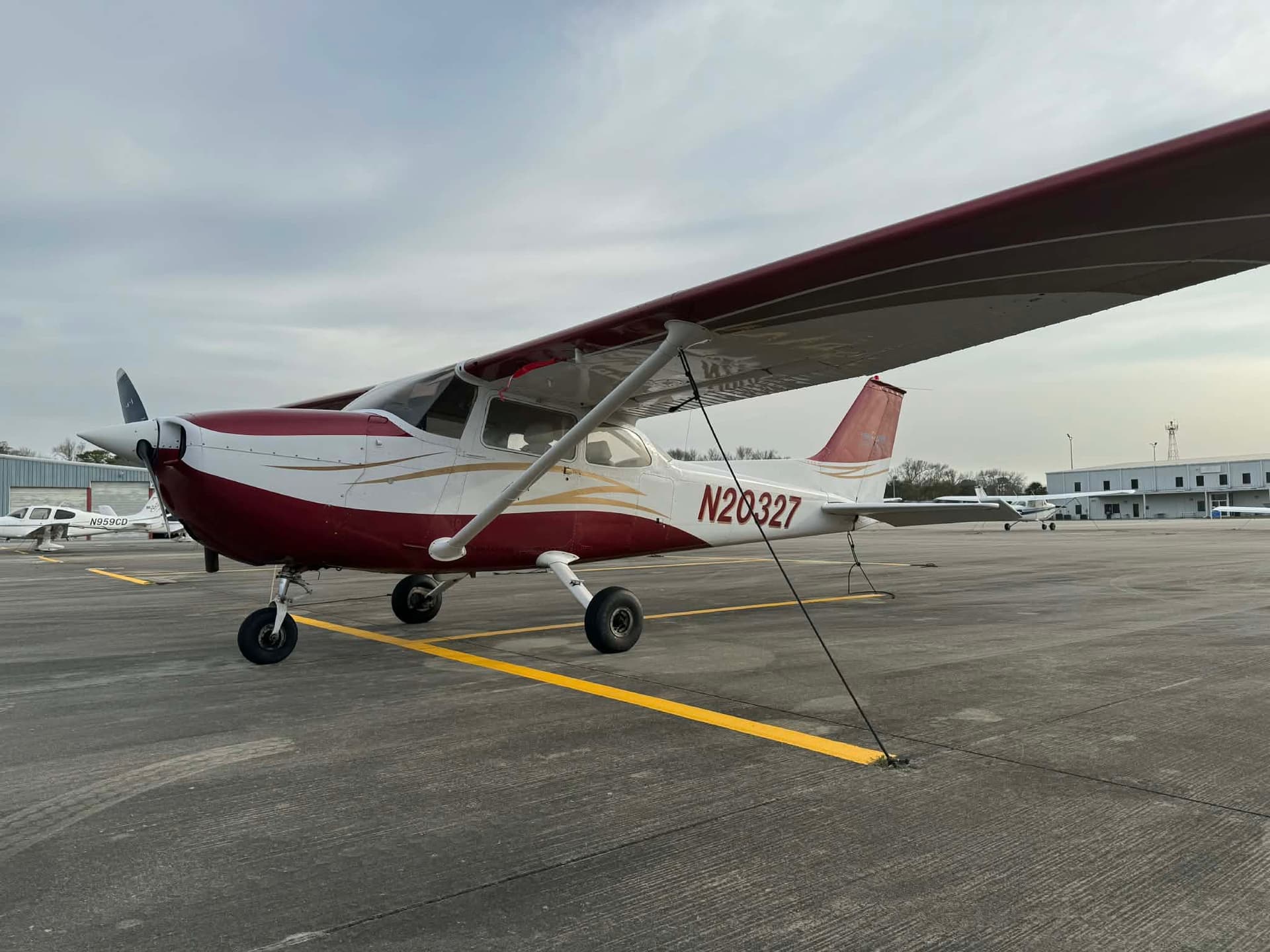 BHA · on the ramp at Grand Strand Airport
 Still have a question?
Reach out through the contact page — or just call. We'll help you determine the best next step.
Serving Myrtle Beach · Little River · Conway